Obama is incompetent because he is incompetent. Or, for those who find "incompetent" too difficult to understand: S-T-U-P-I-D. Was, is, always will be. His Harvard degree a conspiracy? But yes! It's called "Affirmative Action". Rumours about illness, medication, a grand conspiracy, are just a smokescreen to conceal the fact that the American people elected him. A stab-in-the-back legend American style. Elected him by choice, I'd like to add, and for the oh-so extracerebral valid reason that it must be wonderful to have a "black" president. Now they have what they wanted. They have an incompetent president and the world STILL doesn't like them any better for their pains to appear "non-racist".

October 31, 2010
The Roots of anti-American Resentment
In my last post Who would have thought so: Obama is incompetent! about the "Obama phenomenon", I briefly discussed its aspects from a European view. The following discussion deserves not to disappear in the depths of the blog bilges.

October 29, 2010
Who would have thought so: Obama is incompetent!
This is the most singularly stupid bit of writing, with comments to match, I have read in a long time:extracerebral valid reason that it must be wonderful to have a "black" president. Now they have what they wanted. They have an incompetent president and the world STILL doesn't like them any better for their pains to appear "non-racist".
A US analyst says US President Barack Obama is unlikely to end his first term as there are serious efforts by American officials to remove him due to his incompetence.But then it gets really bad:
“It is very doubtful at this time that he will last his first term,” Edward Spannaus of Executive Intelligence Review said in an interview with Press TV on Wednesday.
“There are people who are upset within the administration and the Democratic party who are seriously considering how to remove Obama from presidency,” Spannaus added.
Many of them put out all their calls for removing Obama under the amendment 25th of the US Constitution.
The amendment allows for the removal of the US president if he is incapacitated either physically or mentally.
Spannaus also opined that people in the military are upset because Obama “is not attentive” to what is going on. “We have troops killing and being killed and he is not interested in dealing with it,” he further explained.
Elsewhere in his remarks, Spannaus said people inside the White House say, “Once he got into the White House he is very unhappy having to govern …
... he is very frustrated, he is very depressed, some reports say he is on medications and he cannot concentrate or focus, which is a mental problem.”With comments like, for example:
“It is the question of what he is going to do now in this term, the question of the second term is out of the question,” he concluded.
tertiary Syphilis . . . Sickle cell anemia. AIDS, remember there were a lot of rumors of him being gay or bi. His lovers that were killed from his church . . . blah blah blah Thus enabling the real puppet master to come forth and take control of a manipulated crisis.Of course, there are a couple of intelligent comments as well, for example the one that pointed at Edward Spannaus' La-Rouche-ian background, or this one:
lastconservativeblackmanonearthAmen! Obama is incompetent because he is incompetent. Or, for those who find "incompetent" too difficult to understand: S-T-U-P-I-D. Was, is, always will be. His Harvard degree a conspiracy? But yes! It's called "Affirmative Action". Rumours about illness, medication, a grand conspiracy, are just a smokescreen to conceal the fact that the American people elected him. A stab-in-the-back legend American style. Elected him by choice, I'd like to add, and for the oh-so
October 28, 2010 at 7:26 pm
always remember that Obama isn’t the problem … it’s the suk-butts that voted for him
October 26, 2010
Again: I told you so, Americans!
Here's another "Educating Americans" entry, part of the backlog due to my blog block. Our oh-so-conservative (I always get a neck like a red biscuit tin if I see that epithet applied to that woman) chancelorette's contradicting statements re Islam were met with interpretations from plainly wrong via deeply silly to patently ridiculous and only a very few twigged that she is simply as timeserving as a streetwalker, just less ethical.
Since our Catholic head of state -- that's the one with the tattooedconcubine second wife Merkel hove into office -- called Islam a part of Germany, things have become a bit muddled here. Of course, he is right, he just doesn't mean it that way. Islam is a part of Germany, as I have written many times before, since the German elite embraced the "Grand Mufti of Jerusalem" as co-organiser for the Holocaust and certified Islam to be a practical and attractive religion for soldiers. Elite and opinion makers still love Islam, just changed the reasons for it a bit, and when Merkel then made that contradicting statement about "Mulitikulti" having failed, the confusion was complete. In fact, she could have said that the moon is made of green cheese with as much conviction.
The fact that a considerable part of the voting public didn't take too kindly to Merkel's head of state pro-Islam rhetoric -- Thilo Sarrazin must have hit a rare bulk backbone-nerve -- made her backpedal like a Tour de France contestant down L'Alpe d'Huez. As I put it in the comment section of an earlier entry here: that woman is an utter opportunist. She has come to understand that her spineless stance in the Sarrazin affair hasn't won her any brownie points with her potential elctorate. Never forget that she weasled her way all through the most vile of all Eastern Bloc communist systems.
I explained, too, why it drives me up the wall if Christian Democrats are labelled "conservatives". They are Sacré Coeur Socialists, always have been. When I was a child, a Protestant in a leading position in the "C" parties used to be somewhat suspicious. It was a Catholic stronghold with a notable wing close to the Catholic social teachings. The few remnants of former political glory of this old representative of political Catholicism have been utterly destroyed by the Communist Protestant pastor's daughter by now.
Why is it so difficult to understand that? Just keep in mind that she was born in Hamburg (West Germany for those of you who don't know) and her parents went from there to the Stalinist GDR, the most suppressive of all dictatorships behind the Iron Curtain, out of their own free will when she was a child and where she grew up, was socialised and politicised. Can you tell me about the mind of somebody who made such a decision? Again: THAT was the environment in which Merkel grew up. And later, after the fall of the Iron Curtain, she joined the Christian Democrats without missing a beat and made a career as Helmuts Kohl's "Mädel" (girl), as he put it so endearingly. Now go figure.
 Bonn, 25.06.1992: Angela Merkel, then Minister for Women and Youth in Helmut Kohl's cabinet together with her mentor. There she accomplished "equal opportunities" law and the "right" of patents to a nursery place for their children. "Conservative", Christian Democrat, family policy at its finest.
Here, here, here, here, here and here I commented on our chancellorette. Read it and THEN get an opinion.
 I wrote, for example, about the above cartoon, showing Merkel reproaching Pope Benedict ("That's a no no, Ratzinger! As far as Holocaust denial is concerned you'll have to set things straight at your end at last, got me?!!") while protesters outside her window are shouting: "Kill the Jews", "Jews to the gas" and "Allah bless Hitler", as it, in fact, happens in Germany. The caption says: "Sweeping at a remote door in the limelight", referring to the German proverb saying that one ought to "sweep [away the dirt] at one's own front door first". During a press conference Merkel had demanded from a great height that, in the affair about the ex-excommunication of renegade Bishop Williamson by Pope Benedict, that "it must be dealt positively with the Jews", adding: "As far as I see, these matters have not been satisfactorily clarified yet." What made this so interesting, and, typically, it was largely overlooked by the mainstream media, was that she made the above statement while standing beside Nursultan Nasarbajew, the president of Kazakhstan, because the press conference was the one following his state visit. Nasarbajew, the autocrat, Nasarbajew, weighed down by international accusations of corruption, Nasarbajew, the Sunni Muslim.
 No, dear Americans, believe me: That woman won't do anything about anything (but ANYthing) that is near and dear to YOUR hearts.
Since our Catholic head of state -- that's the one with the tattooed
The fact that a considerable part of the voting public didn't take too kindly to Merkel's head of state pro-Islam rhetoric -- Thilo Sarrazin must have hit a rare bulk backbone-nerve -- made her backpedal like a Tour de France contestant down L'Alpe d'Huez. As I put it in the comment section of an earlier entry here: that woman is an utter opportunist. She has come to understand that her spineless stance in the Sarrazin affair hasn't won her any brownie points with her potential elctorate. Never forget that she weasled her way all through the most vile of all Eastern Bloc communist systems.
I explained, too, why it drives me up the wall if Christian Democrats are labelled "conservatives". They are Sacré Coeur Socialists, always have been. When I was a child, a Protestant in a leading position in the "C" parties used to be somewhat suspicious. It was a Catholic stronghold with a notable wing close to the Catholic social teachings. The few remnants of former political glory of this old representative of political Catholicism have been utterly destroyed by the Communist Protestant pastor's daughter by now.
Why is it so difficult to understand that? Just keep in mind that she was born in Hamburg (West Germany for those of you who don't know) and her parents went from there to the Stalinist GDR, the most suppressive of all dictatorships behind the Iron Curtain, out of their own free will when she was a child and where she grew up, was socialised and politicised. Can you tell me about the mind of somebody who made such a decision? Again: THAT was the environment in which Merkel grew up. And later, after the fall of the Iron Curtain, she joined the Christian Democrats without missing a beat and made a career as Helmuts Kohl's "Mädel" (girl), as he put it so endearingly. Now go figure.
 Bonn, 25.06.1992: Angela Merkel, then Minister for Women and Youth in Helmut Kohl's cabinet together with her mentor. There she accomplished "equal opportunities" law and the "right" of patents to a nursery place for their children. "Conservative", Christian Democrat, family policy at its finest.
Here, here, here, here, here and here I commented on our chancellorette. Read it and THEN get an opinion.
 I wrote, for example, about the above cartoon, showing Merkel reproaching Pope Benedict ("That's a no no, Ratzinger! As far as Holocaust denial is concerned you'll have to set things straight at your end at last, got me?!!") while protesters outside her window are shouting: "Kill the Jews", "Jews to the gas" and "Allah bless Hitler", as it, in fact, happens in Germany. The caption says: "Sweeping at a remote door in the limelight", referring to the German proverb saying that one ought to "sweep [away the dirt] at one's own front door first". During a press conference Merkel had demanded from a great height that, in the affair about the ex-excommunication of renegade Bishop Williamson by Pope Benedict, that "it must be dealt positively with the Jews", adding: "As far as I see, these matters have not been satisfactorily clarified yet." What made this so interesting, and, typically, it was largely overlooked by the mainstream media, was that she made the above statement while standing beside Nursultan Nasarbajew, the president of Kazakhstan, because the press conference was the one following his state visit. Nasarbajew, the autocrat, Nasarbajew, weighed down by international accusations of corruption, Nasarbajew, the Sunni Muslim.
 No, dear Americans, believe me: That woman won't do anything about anything (but ANYthing) that is near and dear to YOUR hearts.
I told you so, Americans!
Two years plus two weeks ago I wrote in an entry headed Labour of Love
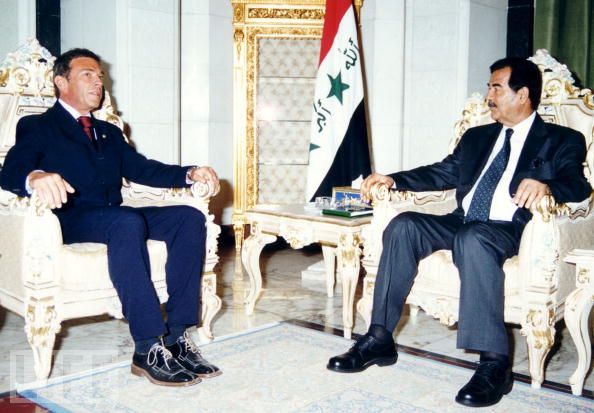
Now it transpires that the German secret service Bundesnachrichtendienst (BND) paid for Haider's trip to Iraq in 2002, as Austrian weekly Profil reported on Sunday.
It seems that the BND was interested in Haider's Iraqi contacts and used the services of an unidentified Austrian businessman to organise the trip and pay for the flight. According to the report, the BND spent "several hundreds of thousands" of Euros in observing Haider and his activities. According to Profil, the BND declined to comment on the information.
Last August, Profil and other Austrian media reported that Haider deposited 45 million Euro (63 million USD) over the years in secret accounts in Liechtenstein. Allegedly, the money came from the Libya's Ghaddaffi and Iraq's Saddam Hussein.
I spell it out to you again: Before you start ecstatically drooling over some "anti-immigration" politician in Europe, ask some questions first. That isn't asked too much, or is it?
While the well-meaning but -- to put it politely -- slightly one-dimensional Americans tend to throw a hearty "he was a patriot" after every dead Nazi towards hell because HE opposed immigration and THEY don't know their arses from their elbows, i.e. squat about German history, society and mentality, the Austrian liberal newspaper "Der Standard" gives us a more complex insight into the now dead mind of Jörg Haider, governor of the Austrian state of Carinthia, the man who thought that he could always get away with driving at more than 140 km/h on a road designed for 70 km/h.The following day I wrote:
The question to end all questions is whose fault it was that Haider turned into a Jew-hater -- no, let me rephrase: that "he resorted to political non-correctness". Don't fret, "Der Standard" knows why:"One can regard his antiamericanism and his resorting to political non-correctness as a result of his questionable interpretation of the European past or as reaction to his own rejection, specifically by Israel, who had recalled her ambassador from Vienna when [Haider's then party] the FPÖ became part of the government in 2000. Also, Haider was probably looking out to extend his influence to the international stage, and nobody else wanted him.Yes, we cried too. If he hadn't been such a cuss with his obsessive antiamericanism, VDare might have even thrown a dirt cheap regular column after him. Who knows, maybe they did and he politely declined. I'm sure he had, in his own way, higher standards than VDare and their ilk.
So Haider really loved the Jews, but, like with his parents before him, this love remained unreciprocated, whereupon he turned into a Jew-hater and flirted with Arab dictators who are, as we all know, nothing but frustrated lovers of the Jews as well.
[...]
When will you Americans finally twig that THERE ARE NO "conservatives" in Germany and that those who can be considered "patriots" hate your guts and will get at your throat rather sooner than later, given the slightest opportunity, Haider and his ilk included. Why, do you think, are they all, left right and center, rubbing elbows even with the most despicable of Islamic dictators? Because they really like them? Their looks? Their smell? Their dress sense? You must be joking.Just reminding, and read the comments to the latter entry as well.WHAT we have are brown-painted Socialists, Sacred-Heart Socialists, green-over-brown-painted Socialists, Communists and a tiny, hapless "liberal" party that used to be a receptacle for old Nazis after '45 and which has ousted itself from serious politics by their self-consciously cultivated image of a "fun party". [Edit: Here I was wrong. In the meantime the liberals have become part of the ruling coalition with its openly homosexual leader who recently "married" his "partner" as foreign minister.]
The staple of all of them is the hatred of America and Jews, which the not-brown-painted ilk insist to call "anti-Zionism" because they are such despicable hypocrites.
Now it transpires that the German secret service Bundesnachrichtendienst (BND) paid for Haider's trip to Iraq in 2002, as Austrian weekly Profil reported on Sunday.
It seems that the BND was interested in Haider's Iraqi contacts and used the services of an unidentified Austrian businessman to organise the trip and pay for the flight. According to the report, the BND spent "several hundreds of thousands" of Euros in observing Haider and his activities. According to Profil, the BND declined to comment on the information.
Last August, Profil and other Austrian media reported that Haider deposited 45 million Euro (63 million USD) over the years in secret accounts in Liechtenstein. Allegedly, the money came from the Libya's Ghaddaffi and Iraq's Saddam Hussein.
I spell it out to you again: Before you start ecstatically drooling over some "anti-immigration" politician in Europe, ask some questions first. That isn't asked too much, or is it?
The Potential of Attention Whoredom
Have you ever seen something quite as grossly nauseating as that?
However, it's the circumstances that are really remarkable. Here we have somebody who converted to Islam, half-sister to somebody for whom the description "has been" would be quite apropos, and all the world is as ecstatic as if the Pope had. And now we have to suffer the ubiquitous pictures of another sickeningly simpering blonde clad in a headrag. The phenomenon that lets women put on a self-congratulatory, smug smirk as soon as they are wearing such a piece of cloth, is something else!
I educated myself about her because I had never heard of her before. At home, she enjoys (You BET!) a modest notability as a TV personality, just exactly the vulgar, obnoxious lower class broad with a horrible accent one would expect, who makes the max out of her faint connection with the pre-previous PM.
There is only one possible explanation. The corrupted media, hell-bent on the Islamisation of the West, are hoping for copycat conversions because they know quite well that women will fall for any (but ANY) little bit of potential attention whoredom, however cheap, however dangerous, however evil.
However, it's the circumstances that are really remarkable. Here we have somebody who converted to Islam, half-sister to somebody for whom the description "has been" would be quite apropos, and all the world is as ecstatic as if the Pope had. And now we have to suffer the ubiquitous pictures of another sickeningly simpering blonde clad in a headrag. The phenomenon that lets women put on a self-congratulatory, smug smirk as soon as they are wearing such a piece of cloth, is something else!
I educated myself about her because I had never heard of her before. At home, she enjoys (You BET!) a modest notability as a TV personality, just exactly the vulgar, obnoxious lower class broad with a horrible accent one would expect, who makes the max out of her faint connection with the pre-previous PM.
There is only one possible explanation. The corrupted media, hell-bent on the Islamisation of the West, are hoping for copycat conversions because they know quite well that women will fall for any (but ANY) little bit of potential attention whoredom, however cheap, however dangerous, however evil.
October 13, 2010
The Neverending German Autumn
On October 13, 1977, 33 years ago, flight LH 181, the Lufthansa Boeing 737-200 "Landshut" with 91 people on board, several children and five crew members among them, was hijacked by Palestinian Arab terrorists on a trip from Palma de Mallorca to Frankfurt/Main, an event that marked a new level of terrorist brutality and government response in Germany.
The hijacking was the means to the end of freeing eleven Baader-Meinhof/Rote Armee Fraktion (RAF) terrorists from prison. Crew and passengers had to fly several sectors to various airports in the Mediterranean and the Middle East under threat of death by guns or explosives. From Rome, via Larnaca, Bahrain and Dubai they finally reached Aden. Because Yemeni authorities had blocked Aden airport, captain and first officer, facing the fact of being almost out of fuel, managed to land, in a maneuvre of unique aeronautical mastership, the 30 meter long jet safely on a sand strip nearby. At Aden it was, that Captain Jürgen Schumann was forced to kneel down in the aisle, in front of his passengers and the crew, and executed.
After the cold-blooded murder of his captain Jürgen Schumann, first officer Jürgen Vietor had to fly the 737, which had just undergone a gruelling emergency landing, solo, to land safely at Mogadishu, Somalia, an airport, that had before, literally and metaphorically, not been on his, a Boeing 737 pilot's, map. Both "Landshut" pilots had a military background, Captain Schumann had flown Starfighters with the German Luftwaffe, his first officer used to be a navy pilot.
At Mogadishu airport, passengers and crew were forced to undergo an ordeal of almost twenty more hours before an elite unit of German federal police, the GSG 9, finally and successfully raided the plane, killing three of the four terrorists and only hurting one of the hostages. Somalia's dictator Siad Barre, hoping for German aid -- arms -- had allowed the deployment of the GSG 9 in spite of his Palestinian-friendly position. All the other countries, as recently de-classified documents show, had buckled under the fear of terrorism.
The heads of the Baader-Meinhof gang at Stammheim prison commited suicide only hours later, The body of Hanns Martin Schleyer, president of the German employers' association, who had been held hostage by the Baader-Meinhof gang, was found the next day. He, too, had been murdered -- execution style.
 The Landshut in Rome. Italy refused to comply with German wishes and let the aircraft take off.
 The odyssey of the Landshut. (For the translation of the captions many thanks to Anders Denken.)
 On October 12, 2007, the Frankfurter Rundschau published a fascinating interview performed by Mark Obert with Jürgen Vietor, which I luckily happened to save, as it is now offline. I translate a few excerpts here. It offers a remarkable bit of insight of the mentality of this rare breed of elite pilots, whom we owe so much.
 Jürgen Vietor and flight attendant Gabriele Dillmann 1977
 Jürgen Vietor and Gabriele von Lutzau 2007
The "Landshut" served the Deutsche Lufthansa until 1985 and then went on an odyssey serving many more owners around the globe. Until January 2008 she flew for TAF Linhas Aereas under the registration number PT-MTB in Brasil. Since January 2008, after 38 years and about 30,000 trips, she is now placed as a monument of herself in a remote spot of Fortaleza airport. The name "Landshut" is still in use by the Lufthansa. Currently, an Airbus A330 is thus named.
Jürgen Vietor retired after 25 years of flying for the Lufthansa. In November 2008, he gave back his "Federal Cross of Merit", the Bundesverdienstkreuz when the former RAF-terrorist Christian Klar was about to be released from prison after having passed his "life sentence". "Setting Klar free is an insult to all of the RAF's victims," Vietor wrote in a letter to Germany's then head of state, President Horst Köhler.
The Bavarian town of Landshut named a street after Jürgen Schumann and the Lufthansa the building of their flight training school in Bremen. Different from Jürgen Vietor, Schumann can not give back the Bundesverdienstkreuz that had been awarded to him posthumously.
 Monika Schumann is still, so it can be safely assumed, serving HER life sentence
 From October 1964 until June 1965, Leutnant Jürgen Schumann received training at Luke AFB under Colonel James Jabarra. Memorial page here (in German).
Waltrude Schleyer's life sentence ended when she died on March 21, 2008 at the age of 92, more than 30 years after the RAF murdered her husband.
 Chancellor Helmut Schmidt condoling with Waltrude Schleyer.
Former Chancellor Helmut Schmidt, the man whose strength, authority and brains saw Germany safely through the most difficult time since WWII, the man who had to face the gruelling predicament of victimising a hostage or giving in to terrorist demands, was, at the age of 89, publicly reproved because his smoking habit was setting a bad example for society, which proves that we have got our priorities right.
 Helmut Schmidt with Waltrude Schleyer at Hanns Martin Schleyer's funeral.
Souhaila Andrawes, the one surviving hijacker, moved 1991 to Oslo with her husband, Palestinian human rights activist Dr. Ahmad Abu Matar and their daughter until she was tracked down by the Norwegian police in 1994 and handed over to Germany in 1995. She was sentenced to 12 years and was released after 3 years due to ill health. Andrawes has since resided in Oslo with her family.
 Andrawes, prophetically, performs the "victory" sign while carried away on a stretcher.
The Federal Republic of Germany, adamant in 1977 never to talk to terrorists again, pledged at a donor conference on December 19, 2007 twenty million Euro for the Palestinians, payable until 2010.
The long-standing relationship with and the care for the Palestinian people by the German mainstream has never been better.
This is a remake of an entry already posted in November 2008. I am still suffering from an acute blog block.
The hijacking was the means to the end of freeing eleven Baader-Meinhof/Rote Armee Fraktion (RAF) terrorists from prison. Crew and passengers had to fly several sectors to various airports in the Mediterranean and the Middle East under threat of death by guns or explosives. From Rome, via Larnaca, Bahrain and Dubai they finally reached Aden. Because Yemeni authorities had blocked Aden airport, captain and first officer, facing the fact of being almost out of fuel, managed to land, in a maneuvre of unique aeronautical mastership, the 30 meter long jet safely on a sand strip nearby. At Aden it was, that Captain Jürgen Schumann was forced to kneel down in the aisle, in front of his passengers and the crew, and executed.
After the cold-blooded murder of his captain Jürgen Schumann, first officer Jürgen Vietor had to fly the 737, which had just undergone a gruelling emergency landing, solo, to land safely at Mogadishu, Somalia, an airport, that had before, literally and metaphorically, not been on his, a Boeing 737 pilot's, map. Both "Landshut" pilots had a military background, Captain Schumann had flown Starfighters with the German Luftwaffe, his first officer used to be a navy pilot.
At Mogadishu airport, passengers and crew were forced to undergo an ordeal of almost twenty more hours before an elite unit of German federal police, the GSG 9, finally and successfully raided the plane, killing three of the four terrorists and only hurting one of the hostages. Somalia's dictator Siad Barre, hoping for German aid -- arms -- had allowed the deployment of the GSG 9 in spite of his Palestinian-friendly position. All the other countries, as recently de-classified documents show, had buckled under the fear of terrorism.
The heads of the Baader-Meinhof gang at Stammheim prison commited suicide only hours later, The body of Hanns Martin Schleyer, president of the German employers' association, who had been held hostage by the Baader-Meinhof gang, was found the next day. He, too, had been murdered -- execution style.
 The Landshut in Rome. Italy refused to comply with German wishes and let the aircraft take off.
 The odyssey of the Landshut. (For the translation of the captions many thanks to Anders Denken.)
 On October 12, 2007, the Frankfurter Rundschau published a fascinating interview performed by Mark Obert with Jürgen Vietor, which I luckily happened to save, as it is now offline. I translate a few excerpts here. It offers a remarkable bit of insight of the mentality of this rare breed of elite pilots, whom we owe so much.
[...]So far Jürgen Vietor's account. What happened further to him and the other participants in the drama?
Are you frequently asked whether you never made the attempt to overpower Mahmud [the leader of the terrorists]
Sometimes.
Do you consider it a reproach?
No, I always tell precisely what happend aboard. One has to understand: We couldn't risk to antagonize Mahmud. There were 86 passengers we had to bring home safely. Our four hijackers defined themselves as freedom fighters, they weren't suicide assassinators like those on September 11. Our hijackers had two goals: The freeing of eleven prisoned terrorists, including those in Stammheim [i.e. the Baader-Meinhof gang members]. And they wanted to survive -- like we did. Based on this common ground we had to cooperate.
And to cope with the fear of the hijackers?
That too. Mahmud's fear played a decisive role at one point. Before we touched down at Aden ... something happened, which explains Mahmuds later atrocious behaviour. He wasn't able to fasten his seatbelt. He sat there like paralyzed because he was obviously scared to death. Therefore Jürgen [Captain Schumann] and I had to fasten his seatbelt. [Vietor explains earlier in the interview that they had to do that because a dead Mahmud bulleting through the cockpit in case of an emergency would have endangered the entire aircraft.] After touchdown, Yemeni military came to the aircraft straight away and talked to Mahmud, who was still upset. Mahmud then told us: "They are adamant to force us to depart. They have issued an ultimatum." Imagine the humiliation for Mahmud: First the thing about the seatbelt and now the rejection by those he had considered his friends. South Yemen was at that time a training center for the PLO. [Notabene that the Baader-Meinhof terrorists received training at PLO camps, thus reviving a long-standing tradition of cooperation between Arabs and Germans.]
Did you consider Mahmud's defeat as dangerous for yourself right from the start?
Mahmud had suffered a loss of face. I understood that he was bound to compensate for it sooner or later...
[...]
At that point you have been for two days in the hands of the hijackers already. Did you have a clear picture of Mahmud and the others?
Something like a profile? No. But that they, too, were highly under stress was obvious from the first moment: all the darting around, the shouting and the gun-waving. The first thing Mahmud did was to sport Jürgen Schumann's captain's cap. That's what he wanted to be, Captain Mahmud. After that, one had to assume that he was a psychopath.
Did you anticipate that Mahmud would kill Schumann?
I had to, because Mahmud had in the meantime informed the passengers as well that he was going to hold a revolution tribunal... In Dubai he had selected passengers for execution. Stupefying. Luckily, he didn't go through with it. But then he became more mistrustful and irritated by the minute because he didn't know what Schumann [who had left the aircraft under the pretense of inspecting the undercarriage which might have suffered through the landing on the sand strip, but, so it became known later, had gone to the airport building to plead for the people in the "Landshut"] was up to. That was an additional loss of authority on top of the other humiliation. I had a very bad feeling, but what could I do?
Does the question haunt you?
It is a non-starter, really. I don't know for sure what Jürgen Schumann would have done in my place, but I think he'd done the same. It was the sensible thing to do.
Feelings of guilt can exist in spite of rational decisions.
His death makes me sad.
The hijackers had thrown his dead body out of the aircraft the next day at Mogadishu.
That wasn't quite so. In fact, they've let him down the rear emergency chute.
Is this difference important for you?
It is a little bit less undignified.
Did you know Schumann well?
He was a young pilot, I was young. [Schumann was 37, Vietor 35.] We had first met before takeoff at Mallorca. And during the hijacking there was no opportunity to talk about private matters.
Do you sometimes think of what Jürgen Schumann might have thought on his way back to the plane?
I thought of it a lot, but without result. Now, after the statement of that General [Sheikh Ahmed Mansur, head of the unit that had surrounded the "Landshut" at Aden airport] I see that he must have known what was waiting for him. And so it happened. Exactly between Economy and First Class before everybody's eyes he had to kneel and Mahmud asked him: "Are you guilty or not guilty?" And Schumann said: "I tried to…" Then Mahmud again: "Are you guilty or not guilty". And again Schumann tried to explain what happened, but Mahmud didn't want to know it at all. He murdered the captain to appear as the resolute leader.
Herr Vietor, is it permissable to think that your chance of survival increased because of Schumann's death because now you'd become indispensable for Mahmud?
One can think that. One can ask as well the basic question why Mahmud murdered the captain and not the first officer.
He almost murdered you as well.
Before Schumann died, I was going to be shot dead twice. First, because I wore a Junghans watch with a "J" on the face and a company logo that looks a bit like the Star of David. Therefore Mahmud thought I was a Jew. The second time, because I was caught calling the Baader-Meinhof group, whom Mahmud intended to free, terrorists instead of freedom fighters. Then there were all the denied clearences to land, the emergency landing in Aden. Five days long it was about nothing but to survive the next hour, not to make any mistake, to keep an eye on the technology... Captain Schumann had just been shot dead when the ancillary unit went out. If one doesn't pinch off the battery pronto, one needs a new one. I didn't want to risk that. Therefore I went to the cockpit as fast as possible and had to step over Schumann's dead body, very carefully, over his legs, his arms, and over his head. Gosh, I couldn't even mourn -- the more as it was me who had to fly the aircraft now. Because I had no idea of the condition of the plane, I had at least to try and to delay the takeoff until daylight to have a better chance for an emergency landing in case of technical problems. I thought feverish how to play for time. First I asked ... for manual refuelling... then for weather charts, which won me ten more minutes. In the end, I had to take off in the middle of the night. Believe me, to fly an aircraft that had just gone through such an emergency landing was risky enough and then Mahmud topped it all by telling me that we were flying to Mogadishu. Mogadishu? I had no idea, where that was, I didn't even know where Somalia was. As a first officer on a 737, the farest I had ever gotten was Cairo. Lucky for us, on our maps, which only showed the 737-routes, the southernmost spot was just Mogadischu, two millimeter away from the bottom margin.
How was Mahmud after his act of violence?
Very focused. I needed a first officer. And finally he was where he wanted to be all the time, in the pilot's seat, with Jürgen Schumann's cap on his head.
How did you react to him?
We all behaved just right without thinking much about a strategy. We were cooperative without sucking up to the hijackers just as every instructional film recommends.
[...]
Did it help that you had to concentrate on the technology?
Very. Being ruthlessly exposed to those people was the most difficult thing I had to suffer because I like to be in control. But at least I had something to do whereas the passengers were confined to their seats, belts fastened, without information. They weren't even allowed to speak. And because the sunshades had to be down all the time they didn't even know where we were. Sometimes they were allowed to use the lavatory, that was all. That was much worse than what I experienced -- I believe.
[...]
What do you think [of the fact that the 20th- and 25th anniversaries of the "Landshut" hijacking went almost unnoticed, different from the 30th]?
Maybe the media are so eager because most of the witnesses will be dead in a couple of years. To think of how old the then chancellor [Helmut Schmidt] is now. Not to forget the discussion about the petitions for clemency of Mohnhaupt und Klar [Brigitte Mohnhaupt and Christian Klar were among the masterminds of the "second generation" of the Rote Armee Fraktion (RAF) and the crimes commited during the "German Autumn". The were detained, trialled and sentenced in the Eighties, Mohnhaupt to five terms of life in prison and additional 15 years. After the minimum term of 24 years, she was set free in March 2007 on parole. Klar was sentenced to six terms of life in prison and additional 15 years. 1992 he got an additional life sentence in a different trial and was released on 19 December 2008 after serving over 26 years of his life sentence.] ... This discussion has irritated me very much.
Why?
... When the consequences of terrorism are discussed, it's mostly about the consequences for the state. And now the state is supposed to show mercy because state and society have overcome terrorism. That may be, but have the bereaved overcome it? If somebody is able to show mercy it's the bereaved. I think that Klar and Mohnhaupt deserve more than just those 26 years. They ought to leave prison only in a coffin.
The discussion about pardon [for the Baader-Meinhof terrorists] has offended you.
Very much so. In spite of the fact that my suffering was limited. But I don't even want to begin to imagine how Jürgen Schumann's widow feels, or the widows of Schleyer und Buback [Siegfried Buback, German chief federal prosecutor from 1974-1977, his driver and a security officer, can be considered the first victims of the "German Autumn". They were murdered in a drive-by shooting on April 7, 1977.], or the children of the security officers. I don't intend to mention all the names here, there are so many who were murdered in cold blood. Okay, there may be good reasons to ask for mercy, but then the perpetrator ought to be deserving of it. Does Mohnhaupt? I don't know. But Klar, who is still adamant that the fight insn't over yet? How can he ask a state he is fighting for mercy? That is cowardice. Alright, the president has denied Klar that [in 2007, Christian Klar's mercy petition was rejected], but I fear that Klar will be released sooner or later.
What does a life sentence for Klar mean to you?
Satisfaction? It would go together with my sence of justice. That in any case. I will tell you something: Three of our four hijackers were killed by the GSG 9, and the only survivor, Andrawes, is suffering for life. I am glad for that.
She was shot during the raid and can't walk properly anymore…
… and is in pain. Yes.
Do you wish she were suffering from a bad conscience as well?
How can one determine anything like that? It's not measurable anyway.
[Notabene that Jürgen Vietor's witness account at Souhaila Andrawes' court trial exonerated her in many details because he chose to tell the facts instead of taking revenge.]
[...]
Did you ever have nightmares?
No.
[...]
Never been scared again?
Never.
Did you assess passengers henceforth? Who looks suspicious? Who is acting oddly?
No.
But you surely forewent the "Landshut", didn't you?
I'll tell you something now that is hardly believable. When a colleague asked me years later whether I've ever flown the "Landshut" again, I said that I didn't know.
What? Tourists have nicked pukebags from the "Landshut" and you didn't care whether you had to enter that plane or not?
Wait, it gets even more remarkable: I looked up my old flight schedules. My first scheduled flight after the hijacking was with the "Landshut". Of 80 possible 737-jets the "Landshut". I have proof of that.
[...]
The last hours on October 17 and 18.
Yes, things were coming to a head now. Day five, Mahmud was at the end of his tether. He submitted his last ultimatum. At 15:00 at the latest, the Baader-Meinhof group and the other terrorists were to arrive at Mogadishu or he'd blow us all up. Our last information was that the federal government wasn't going to give in. So they tied our hands behind our backs with the women's nylons, shoved us into seats and fastened the seatbelts. Even the children's seatbelts were fastened. Then they uncorked the duty-free spirit... and emptied the bottles on top of us. "So that you will burn better." Ah well... In the end, they applied plastic explosives everywhere. I had been in the military and saw at once that it looked like the real thing. And the detonators were definitely genuine: brass sheathing. When I looked at the clock it was ten to three.
May I ask a fallacious question?
Whether we didn't fight even then, right?
Is that the question you are asking yourself?
It has been asked before many times. I have always admitted that we let ourselves drive like lambs to the slaughter. But who has never felt a gun at his neck ought to judge very carefully.
What I really wanted to ask is whether it is true that in the face of death one seas a fast-motion playback of one's life.
That is a myth. I saw nothing at all anymore, only the hands of the clock. Now you have ten minutes more to live, now nine, when suddenly, five minutes before time, excited radio voices could be heard from the cockpit. Mahmud came running and asked me how long it would take a Boeing 707 from Frankfurt to Mogadishu. I started to do the numbers. Adrenaline works miracles. Imagine, I hadn't slept even a minute for several days. So I figured out: we are close to the equator, Frankfurt lies 50 degrees north of us, roughly 3000 miles, a bit of slope distance as well: roughly seven or eight hours. That was good because it was exactly the time they had told Mahmud via the radio. Then he cried joyfully: "They'll exchange! They'll exchange!" What a relief.
[...]
Then, when it was dark, the plane was raided. Your second birth.
One can put it like that.
The mission of the antiterror unit GSG 9 was triumphal.
Yes, brilliant.
Was it worth the risk? Just to not having to release eleven imprisoned terrorists?
I never gave it a thought.
You never gave it a thought? The state could have given in and set you free without such a risk.
That is a touchy point. Let me put it like that: Should somebody ask me whether I thought while we were in that situation that the state ought not to budge and I'd reply with yes, I'd lie. We have beseeched the chancellor to allow the exchange, we begged over the radio. Life is important. Who wants to victimize himself. But had I been in front of a TV set I, too, would have said that the state must not budge.
[...]
So you understand [Chancellor Helmut Schmidt]?
His moral dilemma, yes. Guilt and liability are hard to escape. At that time I have simply begged for my life, as Mr. Schleyer did.
The chancellor considered himself to be in a sort of war against terrorism and put himself, together with his crisis squad, almost all of them former Wehrmacht members, in a sort of combat situation.
But it was a war the terrorists waged against the state. That a politician taps into his experience as a soldier I can, as a soldier, understand.
What do you think if hostages are taken in Iraq or Afghanistan. To pay or not to pay?
What is the state supposed to do? To budge? How big is the danger to produce copycat crimes and thus even more victims in the long run? Exactly that is the question to which nobody has an answer. I am not presumptious enough to consider my opinion important just because of my experience as a victim.
[...]
I could have died through a [GSG 9] officer's bullet. Did this thought occur to you?
The government had even taken into account that some of us hostages would die ... It is bordering on a miracle that no hostage and no GSG 9-officer died.
It must have been an incredible ruckus.
The banging away seemed endless and if the GSG 9-boys hadn't hollered all the time we hadn't even known that there were Germans attacking. "Where are you pigs?" "Here, you pigs!"
They hollered that?
Believe it or not. And it felt good to hear it.
[...]
Did you ever talk about that to the GSG-9-commander, Ulrich Wegener, the hero of Mogadishu?
I met him recently for the first time since 30 years. It was very helpful because he was able to explain some details previously unknown to me. For example that at the ladders they got at Mogadishu rungs were missing.
Not a personal word?
Only technical stuff. Nothing deep.
What do you consider deep?
Something like questions of innocence and guilt, like those we just discussed. That is deep. In the sense of profound.
You close yourself off, in a psychological sense?
I don't have any secrets.
[...]
And still, many think you are a hero.
I don't. Heroes look out for danger. I was exposed to it. And even that by mere chance. On October 13, the day we took off from Mallorca, I was on standby when the first officer fell sick and I stood in for him.
Good God, how does one ever say "thank you" for anything like that?
He never said "thank you". I am still waiting for my bottle of bubbly. But seriously, I don't even know the colleague's name. I have never tried to find it out.
Are you sometimes amazed at yourself?
A little bit. And at this point I remember a peculiar thing. When I was with Mahmud in the cockpit, I heard scratching noises and suddenly turned around and saw an empty seat in front of the emergency exit. I thought I go and sit down there. Later I learned that the GSG 9 was watching us with night sights and hoped that I would move away from Mahmud. I don't believe in telepathy but that is truly amazing, isn't it?
Do you believe in luck? In fate? Or is everything mere chance.
We were damned lucky.
There had been children on board.
Yes, it could all have been much more sad than it was anyway.
Have you ever met Jürgen Schumann's widow?
No, never. There isn't anything about her in the media. She must be very bitter.
Mr. Vietor, you are retired. What are you doing now?
My partner and I do a lot of travelling with the camper.
You are divorced?
Yes, and believe me, that really hurt me. I was vitually depressive. It had nothing to do with the hijacking.
Sure.
Sure. I am fine now. I just regret that I can not live in Canada.
Nice and far away.
In Vancouver, wonderful city. But the Canadians don't want a pensioner.
 Jürgen Vietor and flight attendant Gabriele Dillmann 1977
 Jürgen Vietor and Gabriele von Lutzau 2007
The "Landshut" served the Deutsche Lufthansa until 1985 and then went on an odyssey serving many more owners around the globe. Until January 2008 she flew for TAF Linhas Aereas under the registration number PT-MTB in Brasil. Since January 2008, after 38 years and about 30,000 trips, she is now placed as a monument of herself in a remote spot of Fortaleza airport. The name "Landshut" is still in use by the Lufthansa. Currently, an Airbus A330 is thus named.
Jürgen Vietor retired after 25 years of flying for the Lufthansa. In November 2008, he gave back his "Federal Cross of Merit", the Bundesverdienstkreuz when the former RAF-terrorist Christian Klar was about to be released from prison after having passed his "life sentence". "Setting Klar free is an insult to all of the RAF's victims," Vietor wrote in a letter to Germany's then head of state, President Horst Köhler.
The Bavarian town of Landshut named a street after Jürgen Schumann and the Lufthansa the building of their flight training school in Bremen. Different from Jürgen Vietor, Schumann can not give back the Bundesverdienstkreuz that had been awarded to him posthumously.
 Monika Schumann is still, so it can be safely assumed, serving HER life sentence
 From October 1964 until June 1965, Leutnant Jürgen Schumann received training at Luke AFB under Colonel James Jabarra. Memorial page here (in German).
Waltrude Schleyer's life sentence ended when she died on March 21, 2008 at the age of 92, more than 30 years after the RAF murdered her husband.
 Chancellor Helmut Schmidt condoling with Waltrude Schleyer.
Former Chancellor Helmut Schmidt, the man whose strength, authority and brains saw Germany safely through the most difficult time since WWII, the man who had to face the gruelling predicament of victimising a hostage or giving in to terrorist demands, was, at the age of 89, publicly reproved because his smoking habit was setting a bad example for society, which proves that we have got our priorities right.
 Helmut Schmidt with Waltrude Schleyer at Hanns Martin Schleyer's funeral.
Souhaila Andrawes, the one surviving hijacker, moved 1991 to Oslo with her husband, Palestinian human rights activist Dr. Ahmad Abu Matar and their daughter until she was tracked down by the Norwegian police in 1994 and handed over to Germany in 1995. She was sentenced to 12 years and was released after 3 years due to ill health. Andrawes has since resided in Oslo with her family.
 Andrawes, prophetically, performs the "victory" sign while carried away on a stretcher.
The Federal Republic of Germany, adamant in 1977 never to talk to terrorists again, pledged at a donor conference on December 19, 2007 twenty million Euro for the Palestinians, payable until 2010.
The long-standing relationship with and the care for the Palestinian people by the German mainstream has never been better.
This is a remake of an entry already posted in November 2008. I am still suffering from an acute blog block.
Subscribe to:
Posts (Atom)
"Rumours about illness, medication, a grand conspiracy, are just a smokescreen to conceal the fact that the American people elected him."
Yep. Well said Nora. Many Americans were asleep and when Mr. O was preaching "hope and change" a majority did not ask "what are you hoping for and HOW are you going to change things?"
I was extremely concerned by Mr. O's extreme leftist bent as well as the fact that he was the most junior (inexperienced) member of the US Senate. That meant he would ram his ideology through no matter what the populace said. Still I gave him the benefit of the doubt after he was sworn in, but within two months knew my assessment of him was right.
I hate being right in these matters, because our nation is now in a very precarious and dangerous situation. I can tell you that in the last few months, I've seen many former Obama supporters become totally disillusioned with him. A couple I have told "I warned you" without gloating about it.
Sure, there was a political machine backing Obama and helping him along the way, but at the end of the day, it was how Americans pulled the voting levers that put him in office.
29 October, 2010 16:58
Editrix said
“This is the most singularly stupid bit of writing, with comments to match, I have read in a long time:”
I have to agree with you. I’ve never heard anyone make these claims about those from within the administration or Democratic Party wanting to remove Obama. Now during this mid-term election time there are some Democrats who are running or up for election who maybe gently distancing themselves from or at most disagreeing with Obama and mostly with Rep. Pelosi. Those on the left are still supportive of Obama but it’s the far left that is upset with him, but not on the basis of his competence but that he is not being leftist enough. I think Obama is going to have a problem winning a second term in 2012. But that really depends on who’s running against him. As in most elections in America the winner is the one who can pull the most independent voters.
I tend to agree with you on why Obama was elected. Whether people want to admit it or not I think it was because of his skin color. Many whites in America wanted to get the race issues and White guilt behind them and they though electing a Black for President would do that. Democrats thought it so much that they felt it was more important to nominate an inexperience 1st term junior Senator who was Black over a woman who was an experience 2nd term Senator and was also a former 1st Lady and dedicated life long Democrat. It was more important to for Democrats have the first Black as President than it was to have the first woman as President. And more young Americans voters really wanted to prove that racism is dead and most are brainwashed into thinking that conservative are old, out of touch and evil white people. But now I think many young people have become disillusioned with their choice because they are now seeing the reality of the politics, government and the world. I didn’t vote for Obama but it had nothing to do with his skin color, I just wasn’t buying what he was selling. He gave great speeches but really said nothing. But a lot of people thought he did. One woman even believed that once he became President she would get free gas. Truth is people heard what they wanted to hear.
Now what I find strange is the idea that American liberals and many young people have that Europe would respect us if we elected a Black as President. Was it really important in Europe for America to have a Black President? If so, why? How many countries in Europe have ever had a Black leader?
Why are Americans hated in Europe? Is it our government? Is it our way of life? Or is it us as a people? Do we come off as arrogant or ignorant or both?
29 October, 2010 20:33
'gator: To be honest, I can relate to the gut feeling of watching AT LAST the perceived justice of a black American president. But it is just that: a (passing) GUT feeling. Then all my cerebral alarm bells rang. But I am sure the inner strength of the American people will eventually be able to cope with the situation the election of this "post racial" president has brought about.
UR: "Now what I find strange is the idea that American liberals and many young people have that Europe would respect us if we elected a Black as President. Was it really important in Europe for America to have a Black President? If so, why? How many countries in Europe have ever had a Black leader?"
No European country ever had a black leader, but then, none had slavery and if it had once had close-to-slavery conditions, like Tsarist Russia, the victims were of their own kind, i.e. white. So "white guilt" is a stranger to the European subconscious. I don't think the Obama-hype in my country had anything to do with an increased respect of America. In fact, the opposite was the case. I am sure people sensed Obama's inherent anti-Americanism and responded positively to THAT.
"Why are Americans hated in Europe? Is it our government? Is it our way of life? Or is it us as a people? Do we come off as arrogant or ignorant or both?"
There isn't a simple "yes" or "no" answer to that. I think French anti-Americanism is due to the fact that you saved their sorry arses twice during the last century. German anti-Americanism is a bit more involved. I said before that Germans are no more racist (in fact, less, or so I think) than other European peoples. Always remember that our main identity-creating state, Prussia, was a political, not a tribal entity. Racial conflicts were, different from the British isles, largely unknown within the German countries. The lack of any notable colonies added to that because it kept Germany largely white. The Poles who came to work in the West German mines in the 19th century have been thoroughly absorbed, the "Gastarbeiter" one century later as well, and towards the un-absorbable Turks we are hatching an attitude of proactive obedience and dhimmitude.
No, our problem isn't racism, it's antisemitism, and here we come (I think) to the core of anti-Americanism. The American people are serving as a projection screen for German antisemitism. Not uncommon points like, say, the "Jewified East Coast" (verjudete Ostküste) are proof of that. Of course, this is not JUST antisemitic, but issue of German anti-modernism as well, but the borders between those phenomena are blurred. There are shadows of envy of a (really or perceived) more successful, better functioning and more happy society as well, and, again, here we come back to (dare I say it?) antisemitic elements.
Like with antisemitism, there is nothing Americans can DO about it, because anti-Americanism is, like antisemitism, not a prejudice (prejudices can be rectified), but a resentment.
I think we all have to come back to a common ground of Western solidarity and to acknowledge what is different and why and to stress the mutual interests. And one day, maybe, perhaps, we will see hat we can actually learn from each other.
31 October, 2010 14:56